
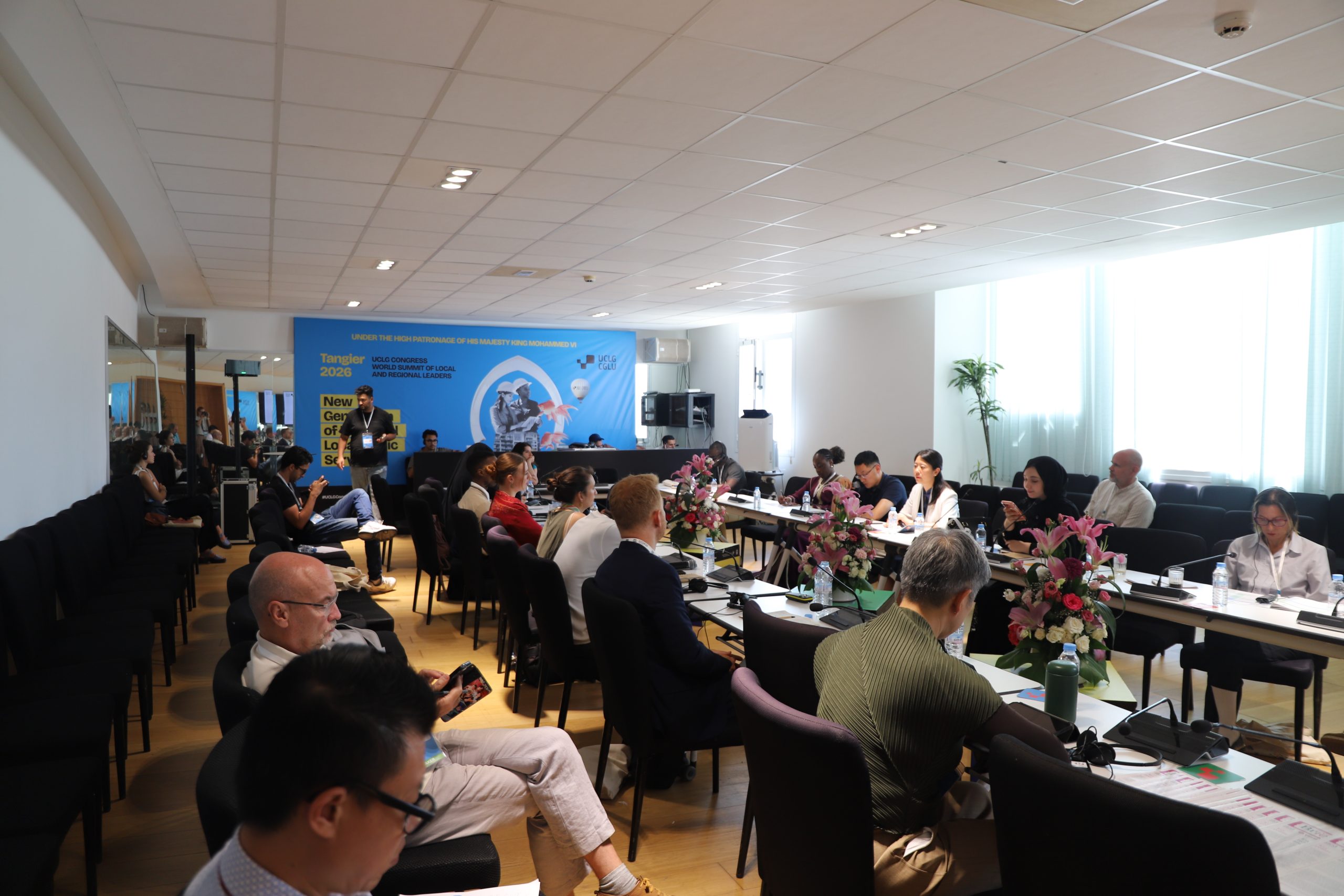
More than 3,000 delegates and representatives from around the world gathered in Tangier, Morocco this year for the United Cities and Local Governments (UCLG) Congress. Mayors, city officials, civil society leaders, and youth advocates from every region came together under one roof, all wrestling with the same underlying question: what does it actually take to build cities that work for everyone?
Walking through those halls, it was hard not to feel the weight and the promise of the moment. Each conversation, whether in a formal session or over coffee between panels, circled back to the same idea: that local governance is where the future of our communities is actually decided, one policy and one partnership at a time.
I had the privilege of speaking twice during the week, and both moments left me thinking harder about the work still ahead of us.
A Partnership Two Years in the Making
On Tuesday, the first day of the conference, I had the opportunity to speak on behalf of young people in the City of Kitchener, sharing the story of the partnership between the City and its youth.
I talked about how this relationship strengthened through Bloomberg Philanthropies‘ Youth Climate Action Fund, led by Claudia Juech and Mayor Berry Vrbanovic launched two years ago has since built real trust and collaboration between both stakeholders.
What started as engagement has grown into something more: a true partnership. Young people in Kitchener are not just contributing ideas from the sidelines anymore. They are actively working alongside the city to co-create its future, shaping climate action plans, sitting at decision-making tables, and holding real influence over outcomes that will affect their generation the most.
Speaking on that stage, representing a city thousands of kilometers away, I was reminded of how rare this kind of partnership still is globally. Many cities are still figuring out how to move past consultation and into genuine collaboration with young people. Kitchener’s experience is not perfect, but it is a working example of what is possible when a city commits to the relationship for the long haul.
Lessons from Seven Years in the Field
On Thursday, I spoke again; this time during the Youth Leadership in Urban Governance discussion. I reflected on my work through Young Eye Foundation and Young Eye International, and shared some of the lessons I have picked up over the past seven years.
It was inspiring to sit alongside other youth leaders – Antoine Agossou, Lauren Banham, and Nakita Aboya and hear how they’re each driving change in their own communities and on the global stage.
If there is one message I kept coming back to, it is this: if we truly want young people to shape decisions, we have to invest in building their capacity to do so. Youth engagement cannot be performative, and it cannot be rooted in tokenism. Inclusion is not just about having young people in the room; it is about making sure they have the tools and the power to actually influence outcomes.
That capacity-building looks different in every context. Sometimes it is mentorship and training. Sometimes it is funding that flows directly to youth-led organizations instead of through layers of intermediaries. Hearing how Antoine, Lauren, and Nakita are each navigating these same tensions in their own countries reinforced something I have believed for years: the challenges young leaders face may look different from place to place, but the underlying barriers, being underestimated, under-resourced, and under-consulted are almostsimilar everywhere.
Gratitude
A huge thank you to Secretary General Emilia Saiz for hosting us, and to María Alejandra Rico, Federico Batista Poitier, and Job Van der Poel for putting together such a successful conference.
It was also a highlight connecting with the Federation of Canadian Municipalities delegation and exchanging ideas on the future of local governance back home. Conversations like these are a good reminder that Canadian cities don’t have to solve these challenges in isolation, there is a whole network of peers wrestling with the same questions, and a lot to learn from comparing notes.
The Takeaway
Congresses like this one can sometimes feel like an exercise in good intentions — a lot of talk about inclusion, without a clear path to action. But Tangier felt different. The energy in the room and the genuine curiosity from city officials in the audience all pointed to something shifting: a growing recognition that young people aren’t a demographic to be managed, but partners already doing the work, often with fewer resources than they deserve.
I left Morocco with a renewed sense of urgency and optimism. Urgency, because the pace of change in our cities from climate impacts to housing pressures to shifting demographics, demands that we stop treating youth inclusion as a nice-to-have. And optimism, because I saw firsthand, in Kitchener’s story and in the stories of leaders from across the world, that the model for doing this well already exists. It just needs more cities willing to commit to it.